Wiring and cable processing lines: industrial cable stripping machines and wiring automation
Cable lines for electrical cable processing are now a central component in industrial manufacturing processes. The evolution of automation has transformed these systems into integrated cable processing lines capable of high precision, operational continuity and reduced production waste.
Within these lines, the industrial cable stripping machines represent the heart of the process: they perform cut-to-length and insulation stripping in a single automated cycle, ensuring repeatability even on high-volume productions.
Companies specializing in the design of industrial wiring machines operate in the sector, such as COMTEC S.r.l., active since 1983 in the development of solutions for automated cable processing, including wire-cutting machines, unwinders and material management systems.
Automated wiring lines: how they work
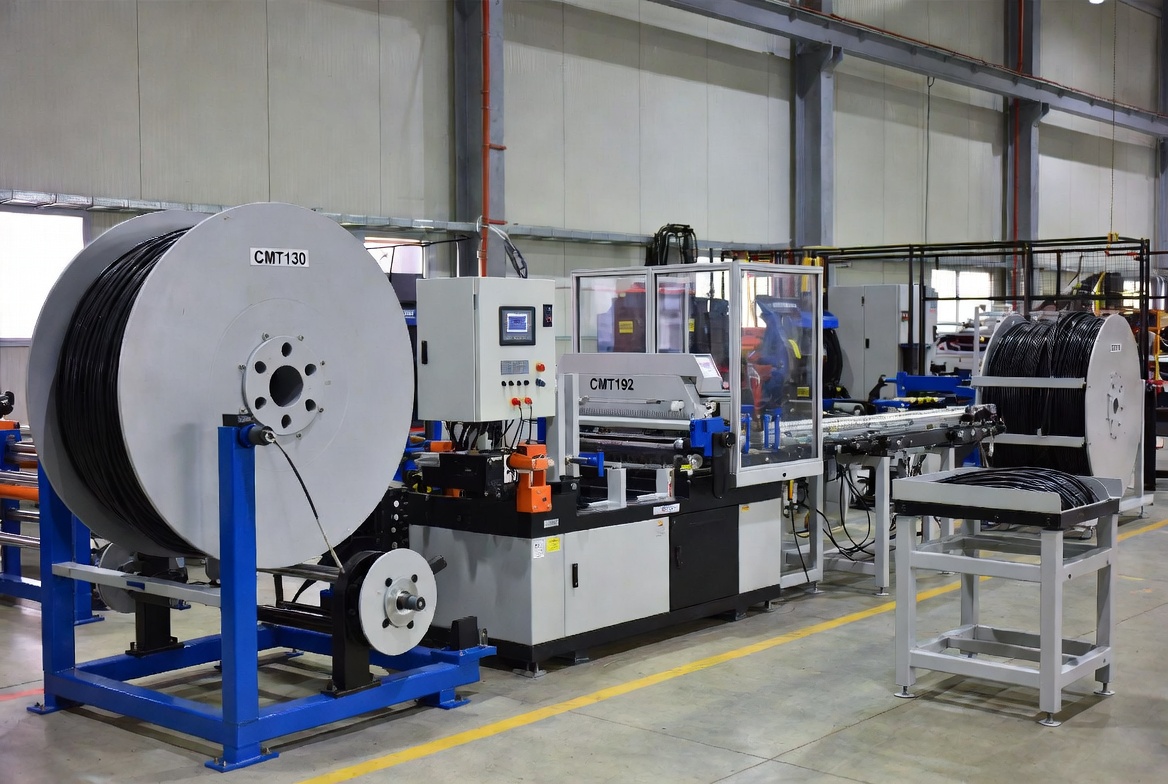
An automatic industrial wiring line no longer consists of isolated machines, but of an integrated system in which every component is synchronized.
A typical configuration includes:
- unwinder for reels or hanks
- prefeeder or loop control
- cable cutting and stripping machine
- finished product collection system
This type of architecture enables a continuous production flow and drastically reduces manual intervention.
Cable feeding: hanks vs. reels
The choice of power system is critical to designing an efficient cable processing line.
Hanks of cable
Used mainly for:
- flexible productions
- small lots
- non-continuous processing
Advantage: simplicity
Limit: less precise tension control
Industrial coils
Coils are the standard in industrial automatic wiring lines.
Used for:
- continuous production
- large volumes
- advanced automation
Advantage: production continuity
Greater compatibility with automated systems
The uncoiler is the first element of the cable processing line and plays a crucial role in the stability of material feeding. Depending on the type of cable feed, unwinders can be configured differently.
In the case of hanks of cable, the following are generally used passive unwinders, simple solutions suitable for flexible or small batch production. This configuration is typical for less complex plants, where advanced synchronization with downstream machines is not required.
When, on the other hand, feeding is by industrial reels, the unwinder becomes a more advanced element of the line. In fact, in these cases, motorized or synchronized uncoilers are used, often connected directly to cable-cutting machines, so as to ensure a continuous and perfectly controlled flow of material.
Prefeeder and loop control: power stability in the wiring line
A cable prefeeder or a loop control system is often inserted between the unwinder and the cable stripping machine. These devices are key elements in modern automated cable lines because they ensure the continuity and stability of material supply.
Their function is not only that of “support,” but of true dynamic regulation of cable flow, regardless of the type of power supply used upstream.
Technical function of the prefeeder
The prefeeder is integrated to improve the behavior of the cable during transit to downstream machines.
In particular, it enables:
- Stabilize cable tension during unwinding
- compensate for accelerations and decelerations of the cutter machine
- Avoid micro-interruptions, blockages or tearing of the material
- Ensure continuous and controlled feeding
- Reduce the mechanical stress on the cable
In practice, the prefeeder acts as an “intelligent buffer” between unwinding and processing.
Loop control for strip-cutting machines: what it is and why it is indispensable
Loop control is an essential peripheral for cable-cutting machines, designed to precisely control cable feeding and feeding during the production process.
This system works without contact, using sensors that monitor the position and tension of the cable in real time, usually in the section between the prefeeder (unwinder) and the strip-cutting machine.
How loop control works
The operation of loop control is based on the creation of a dynamic cable reserve (loop):
- If the cable is too tight, it tends to rise
- Sensors detect this variation
- The system sends a signal to:
- increase the speed of the prefeeder
- Or slow down the cut-throat machine
In this way, the loop control keeps the cable power constant, automatically adapting to changes in line speed.
Prefeeder also with direct feed from rack
An important aspect, which is often underestimated, is that the prefeeder is not limited to systems with coils on traditional unwinders.
In modern industrial lines, in fact, it can also be used when feeding through reel racks, where the cable is taken directly from static supports.
In these configurations, the prefeeder still serves to:
- adjust the line input voltage
- Uniform the flow of the cable coming from the rack
- Avoid variations due to the position or residual diameter of the coil
Industrial cable stripping machines: the heart of the system
Industrial cable stripping machines are the center of the production line.
Their main functions are:
- precise cutting of cable to length
- Removal of insulation (stripping)
- high-speed repetitive machining
Main benefits of cable stripping machines:
- reduction of human errors
- increased productivity
- consistent accuracy
- high quality standard
The most advanced solutions are designed to be integrated into fully automatic wiring lines.
COMTEC S.r.l.: industrial cable processing technologies
In the field of industrial wiring machines, COMTEC S.r.l. is an Italian company active since 1983, specializing in the design and production of:
- cable stripping machines
- industrial uncoilers
- prefeeder and feeding systems
- stackers and maters
- integrated solutions for cable processing
COMTEC solutions are designed for integration into automated wiring lines, with a focus on accuracy, reliability and production continuity.
Advantages of automated wiring lines
The adoption of an integrated cable processing line provides real benefits:
Production efficiency
- continuous material flow
- reduction of downtime
- higher production output
Product quality
- consistent precision in cutting
- waste reduction
- uniformity of wiring
Cost reduction
- less manual intervention
- fewer errors
- increased operational efficiency
Security
- less handling of the cable
- automation of repetitive processes
- reduction of operational risks
End of line: collection and management of cable after processing
After the cutting and stripping stages performed by the cable-cutting machine, the processed material must be handled in a controlled manner in the final stage of the line. This stage, which is often underestimated, is actually crucial to ensure order, traceability and production continuity.
For this reason, industrial wiring lines integrate specific cable collection systems, which can be configured according to the type of finished product and the subsequent logistics or production process.
Cable mats: neat and ready to use collection
Hollow skeiners are responsible for collecting the processed cable and winding it into regular, repeatable skeins according to set parameters (length, inner and outer diameter).
This solution is particularly suitable when the cable needs to be:
- shipped as a finished or semi-finished product
- Reused in subsequent processing by other production departments
In many plants, the skeeter is integrated with automatic tying or labeling systems to improve product traceability.
Stackers: linear management and product separation
Stackers are an alternative solution to matting, designed for when cable does not need to be coiled, but kept in a linear, orderly and separate form.
In this case, the system arranges the cable in a controlled manner on supports or conveyors, avoiding twisting or winding.
Technical function of the stacker
The stacker is designed to:
- Maintain the natural orientation of the cable
- Avoid mechanical stress due to winding
- ensure separation between different lots
- Facilitate subsequent operations (assembly, wiring, secondary cutting)
Functional difference between skeeter and stacker
The choice between the two solutions depends directly on the downstream production flow:
- the skeeter is ideal when the product needs to become a compact and movable logistic unit
- the stacker is preferred when the cable must remain in a linear configuration for later processing or immediate integration into other processes
How to choose an industrial wiring line
The choice of the ideal line depends on:
- cable type
- production volume
- level of automation required
- available space
Correct design of the wiring line maximizes ROI and reduces operating costs in the medium to long term.
Modern automated wiring lines are now an indispensable standard in the processing of industrial electrical cables.
Integration between unwinders, prefeeders and industrial cable stripping machines enables a stable, scalable and highly efficient production process.
In the industry, companies such as COMTEC S.r.l., which has been active in the production of cable processing machines since 1983, contribute to the development of advanced technological solutions for industrial wiring automation.