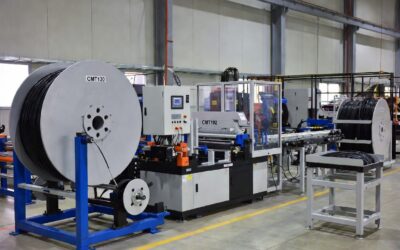
Automatic cable cutting and stripping machines are now essential components in modern electrical cable processing lines. Used in sectors such as industrial wiring, automotive, electronics, and control panel manufacturing, they enable the automation of both length cutting and insulation stripping in a single process.
Thanks to industrial automation, these machines ensure high precision, repeatability, and reduced errors, improving overall production efficiency.
What are cable cutting and stripping machines and what are they used for?
Industrial cable cutting and stripping machines are automated systems designed to:
- cut cables to a precise length
- remove the insulating sheath
- prepare the cable for wiring or assembly
Main advantages
The use of these technologies offers numerous benefits:
- higher production speed
- consistent precision in cutting lengths
- reduction of manual errors
- standardization of wiring harnesses
Types of cable cutting and stripping machines
The machines mainly differ in terms of drive technology and level of automation.
Full electric cable cutting and stripping machines
Fully electric machines use digitally controlled motors for all functions:
- cable feeding
- cutting
- stripping
Advantages
- high processing precision
- advanced digital programming
- low maintenance
- high process repeatability
These solutions are ideal for high-volume automated wiring harness production lines.
Electro-pneumatic machines
They combine electronic control and pneumatic actuators.
Benefits
- greater force for processing complex cables
- good adaptability to materials
- excellent cost-to-performance ratio
They are widely used in production environments with varying types of cables.
Cable feeding systems
The feeding system is one of the most critical components in cable cutting and stripping machines.
It directly affects:
- cutting precision
- stripping quality
- process repeatability
- reduction of waste
Roller feeding system
The cable is pulled by motorized rollers.
Features
- high precision
- simple and reliable structure
- ideal for standard cables
- excellent length control
Opposed belt feeding system
The cable is guided between two motorized belts.
Benefits
- better grip on soft cables
- reduced slippage
- greater stability
- ideal for delicate or flexible cables
Coating materials
Coatings affect grip and processing quality:
- technical rubber: good grip
- polyurethane: high wear resistance
- soft materials: protection for delicate cables
Cable cutting and stripping systems
Machines use different technologies depending on the type of cable.
V-shaped blades
The most widely used system in industrial machines.
Advantages
- high precision
- high speed
- great versatility
- industrial robustness
Radius and shaped blades
Designed specifically for particular cables.
Applications
- cables with thick insulation jackets
- multiple insulation layers
- precision machining
Blades can be customized according to production requirements.
Rotary cutting
It uses rotating circular blades.
Benefits
- very high precision
- minimal risk of damaging the conductor
- ideal for small cables
Longitudinal cutting (slitting)
Used for incisions along the length of the cable.
Applications
- long sheaths
- multipolar cables
- removal of outer sheaths
Advanced functions of skin-cutting machines
Modern machines include such advanced functions as:
- multi-level skinning
- multi-layer insulation removal
- machining on both ends
- stripping on intermediate points
Digital systems allow micrometric adjustments of engraving depth.
Workable cable cross-sections and diameters
Industrial machines cover a wide range of applications:
- micro-cables: from 0.05 mm²
- thin cables: up to 2.5 mm
- industrial cables: up to 6 mm²
- large diameter cables: up to 10-35 mm
Some advanced systems can also process cables up to 240 mm².
Integration into automatic wiring lines
Skin-cutting machines are integrated into complete lines.
Cable power supply
- industrial coils
- hanks
Prefeeder and loop control
They serve to stabilize the flow of the cable:
- speed synchronization
- stress elimination
- tear prevention
Management of the finished product
Automatic flattener
- creates neat skeins
- Prepares material for shipment or storage
Stacker
- linear cable deposition
- ideal for industrial assemblies
Advantages of skin-cutting machines in industrial lines
The use of these technologies offers significant competitive advantages:
- increased productivity
- standardization of wiring
- reduction of waste
- improved operational safety
- integration into automated systems
- reduction of production costs
Cable-cutting machines are a strategic element in the modern wiring industry. The choice of the most suitable technology-full electric, electro-pneumatic or advanced cutting systems-depends on the type of cable, the level of precision required and the production volume.